
Alumni Legacy Series: Roselyn and Florante Ibañez
SIPA’s legacy spans over five decades, and there are hundreds of Filipino Americans who can say SIPA has had a lasting impact on their lives. But what about the people who have shaped SIPA and laid down the foundations for today’s Historic Filipinotown and beyond? This is the focus of our Alumni Legacy series.
In this interview, long-time Filipino American community organizer, Roselyn “Rose” Ibañez, discusses her life and the legacy of her late husband, Florante Peter Ibañez (1951 - 2025). She shares their history as part of the 1970s Filipino student activism movement, highlighting their involvement in founding UCLA Samahan and the UC Irvine Kababayan Club. Rose details Florante’s significant career as a librarian and archivist, noting his contributions to preserving Asian American history. She also reflects on their connection to SIPA, and her hope for the future.
Q: Tell me about yourself, and about your husband, Florante.
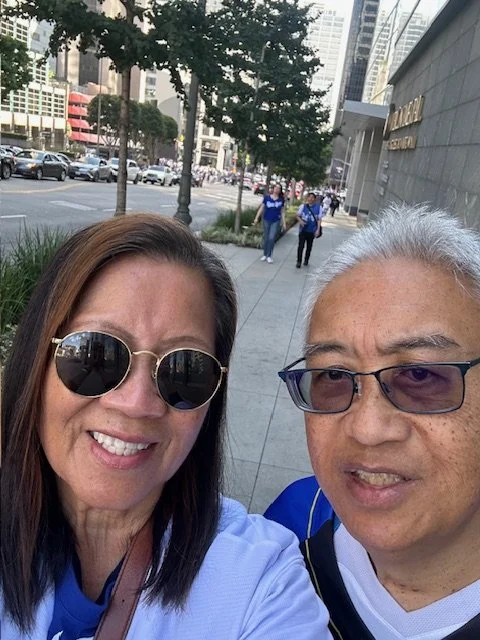
Roselyn and Florante Ibañez.
“I grew up in San Diego, California. I came over from the Philippines when I was only four years old, because my dad joined the Navy. We're part of that Navy family that grew out of Filipinos coming and joining the Navy and bringing over their families. I have seven siblings in our family. I went to San Diego State, met Florante, got married, and moved to UC Irvine with him, and the rest is history!”
“We consider ourselves part of the second generation of the "second wave," since we're both Navy families. Florante also came from that period, but he was actually born here in the U.S. His father was part of the first wave; he came to the U.S. as a single man in the 1920s, then went back to the Philippines after the war to marry Florante's mother, who was twenty years younger than him. At that time, many of the single men were older, and most women their age were already married, so the men who returned to the Philippines to marry were left with the younger women. Florante's mother was actually born here in the U.S., then moved to the Philippines and was raised there. Florante is the only sibling from that marriage. His parents divorced when he was young, and his mother remarried and had more children.”
“We both consider ourselves baby boomers of the 1970s, we grew up during a period of political and social turmoil: the student and identity movements, the anti–Vietnam War movement, the anti–martial law movement in the Philippines, Black Power, Chicano Power, Asian Power, Filipino identity. We didn't really discover our own identity until we got to college. It wasn't until then that Florante became more active. He was working at UCLA and became, as far as I know, the first full-time Filipino staff member at the Asian American Studies Center, around 1970–71. That's when he reached out to other Filipino students he'd met on campus, and together they formed UCLA Samahan with Kaz Tolentino, Jennifer Mascariñas (now Tolentino), and Sheila Napalis Tabag, the four founding members.”
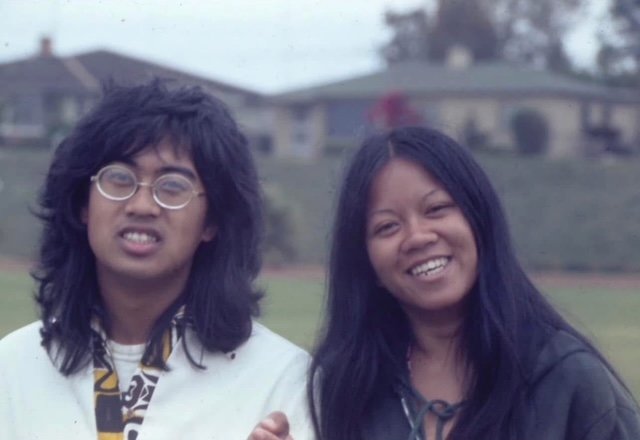
Florante and Rose met in 1973 at the Far West Convention in San Jose, CA.
“I was active at San Diego State, where Samahan had already been formed. We first met in 1973 at the Far West Convention held in San Jose. The convention rotated cities up and down the West Coast, from San Diego to Seattle. We started dating that year, while he was at UC Irvine and I was at San Diego State. He got tired of traveling on weekends to see me, so he proposed just a few months after we started dating. We got married in 1973.”
Q: How were you feeling when he asked you to marry him, after only a few months of dating?
“It's funny, at the time a lot of my high school friends weren't going to college; they were getting married instead. It was almost a peer thing "that's just what you do." A lot of my friends told me, "If he's the one, then that's who you should marry." He was actually my first serious boyfriend, and he was Filipino, which mattered to my dad. My older sister had married a Native American a couple of years earlier, and I thought my parents might not approve of me marrying while still in college, but when my dad met Florante, he was thrilled. He said as long as I finished college, he'd approve. Florante's mother actually spoke to my parents on his behalf, because he was so nervous.”
“Looking back, we were young! I was 20, he was 23. But among my high school friends, that wasn't unusual; some got married right after high school, or even before. My high school wasn't great about encouraging us toward college, my counselor, an older white man, even questioned why I wanted to go. If it weren't for my older sister already being at San Diego State, and the EOP (Educational Opportunity Program) that helped disadvantaged students get to college, I might not have gone either. We came from Sweetwater Union High School in National City, and the education there wasn't strong. I had to retake English composition classes three or four times, even in college.
Florante had a different upbringing. He ran with the "most likely to succeed" crowd. I used to call him the nerd. He was academically bright and musically talented: first chair clarinet in middle school, later picked up ukulele bass, all after learning piano. I told him if we'd met in high school, I never would have dated him, I was the opposite of a nerd back then.”
Q: Tell us about Florante’s path to becoming a librarian
“Before Florante became a librarian he worked in computer tech and union organizing. I went on to get a master's degree through a program under the School for Social Change in Massachusetts. Florante had wanted to go too, but he was in the leadership of the KDP (Union of Democratic Filipinos) at the time, and they needed him to stay. I was able to go because I wasn't in chapter leadership. He was disappointed, but I knew he still wanted to pursue a master's and to teach.”
“After I taught for a year, I moved into political and electoral work instead. I had the opportunity to work with Gloria Molina and wasn't going to pass that up. After I finished my second master's, in public administration, Florante decided it was his turn. He'd heard that UCLA offered a joint master's program in library science and Asian American studies, and he loved it, the whole idea of being a librarian and an archivist.”
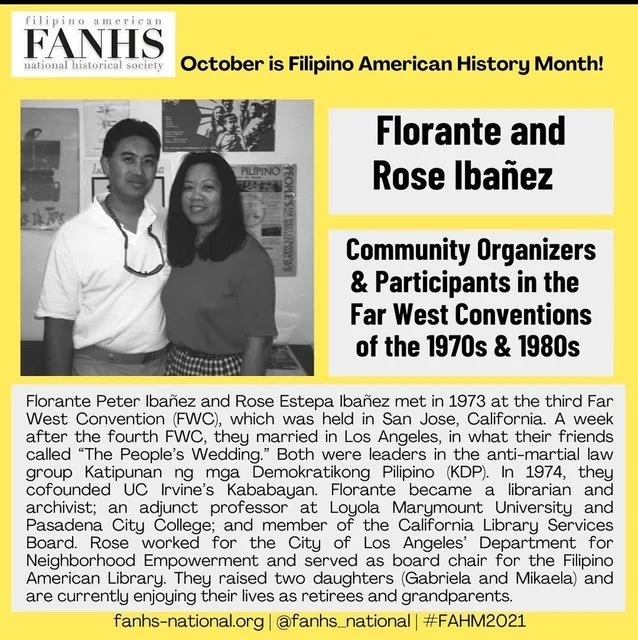
Photo Credit: Filipino American National Historical Society 2021
“He also became a professor in Asian American Studies and got deeply involved in professional organizations, the Asian American Studies Association and the Asian Pacific American Librarians Association (APALA), where he held leadership roles. Whenever we traveled, we visited libraries. I used to worry that everything was becoming digitized and ask him what would happen to libraries, he always said books weren't going anywhere, that people would keep writing and reading even as access expanded.”
“He took real pride in his archival work. He helped place Royal Morales's collection with the Library of Congress's Asian American section, and helped with the Helen Brown collection at USC. He also started his own collection, which now lives at the Cal State Dominguez Hills archive. His expertise as a librarian and archivist helped our community preserve its history and stories.”
“He also held a press pass and loved photography. He volunteered to photograph the Visual Communications film festival every year and served as a resource for the Association for Asian American Studies, photographing their annual conferences.”
“Reflecting on his life, he did a lot. We're still sorting through all his documents. He brought home 30 boxes from work after we retired because there wasn't room for them at the house before that. My daughters and I are slowly going through everything now, though I can hear him in the back of my mind saying, "No, we're not throwing that out — it has to be saved." He used to sit in his study for hours at a time, not sorting, just reading through what he'd saved. It's a bittersweet process.”
Q: Tell me about your entry point into Historic Filipinotown and the SIPA community.
Florante was active with SIPA from its founding, and later became a board member. He worked closely with Roy Morales, one of the founders of the concept behind SIPA. Roy was a social worker who noticed a lot of young Filipinos running away from home and getting into drugs, so he organized a youth gathering at Camp Oak Grove. Florante heard about it through UCLA and got involved early on, alongside Roy Morales, Al Mendoza, and Gina Bella; all founding figures before SIPA officially became SIPA. At the time, it was the only youth organization of its kind in LA, and probably nationwide, which is why so many people supported it.”
“I learned more about SIPA through Florante after we married. He joined the board, and I was working for Gloria Molina, so I tried to help find resources for SIPA, first with Meg Thornton, who ran a mural project we helped fund, and later with Joel Jacinto, both former executive directors.”
“I also want to mention the origin of the name "Historic Filipinotown." Gloria Molina didn't want to simply call the area "Filipinotown," since she also represented the Latino community, and doing so would require broader community agreement. It wasn't until Mayor Garcetti got involved that someone came up with the idea of "Historic Filipinotown" A name that acknowledged the area's history without requiring the same kind of community negotiation. That framing made it easier for people to embrace. At the time, people used to ask me why Molina wasn't supporting "Filipinotown," and I had to explain her position, it was a hard needle to thread until Garcetti's team got behind it.”
Q: How has SIPA impacted your lives?
“It shaped us as young adults, and later, it shaped our children too. We brought our kids to SIPA events so they could learn about our culture beyond what we could teach them at home, especially since there were no Filipino history classes in their schools. Uncle Roy Morales actually taught my daughter parol-making when she was in high school and helped form a Filipino club at Narbonne High School. My older daughter still makes parols with her family and cousins every Christmas. It's something she carries forward because of that experience.”
Q: From your perspective, how has SIPA impacted the broader community?
“SIPA is an institution. It's not going anywhere, whether it's discussed at workshops, conferences, or within Historic Filipinotown itself. In the earlier years, they focused heavily on counseling for young people. Now they've broadened into low-income housing, which is critical given the homelessness issues in the area. I actually worked on homeless funding for the city of LA after my time with Molina, so I know how important that work is. I'm glad for their revived location and the resources they're receiving now, and I'm glad Kimmy, the current executive director, and the board are working closely with the community.”
Q: What are you most optimistic about for the future of SIPA and the youth in the community?
What I share with people is the importance of a multi-generational approach. I'm one of the elders now. There are about five generations below me. When I was in my twenties, we only had one generation above us to learn from, along with our peers and the youth below us. Now there are many more generations to bridge.
As a grandparent, I try to make sure youth are included in everything we do. If we're honoring Filipino American History Month, I want both a youth and an elder represented. I hope SIPA continues to invest in leadership development for young people, not just through college internships, but by recognizing that youth are ready for that kind of responsibility even earlier.”
My grandson is a good example. He formed a club on his campus called Amnesty, focused on protecting people's democratic rights, after spending time during COVID reading everything he could get his hands on. Young people need to hear from every generation above them, and I hope they take that same multi-generational approach as they move through life, learning from everyone they encounter, not just within their own professions or businesses, but across every perspective the community holds.”