
Alumni Legacy Series: Gerald Gubatan
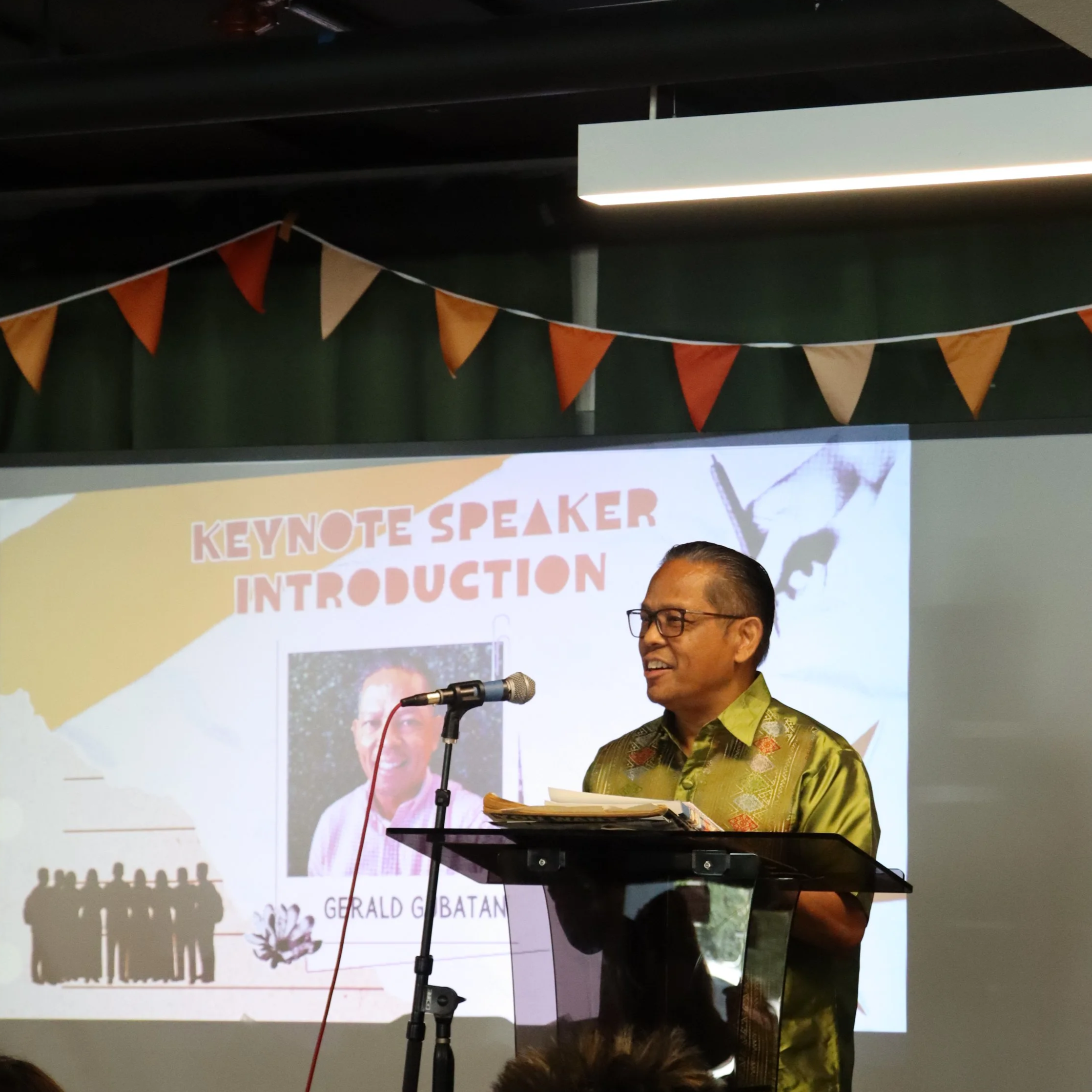
Gerald Gubatan speaking at SIPA’s youth conference. photo credit SIPA.
SIPA’s legacy spans over five decades, and there are hundreds of Filipino Americans who can say SIPA has had a lasting impact on their lives. But what about the people who have shaped SIPA and laid down the foundations for today’s Historic Filipinotown and beyond? This is the focus of our Alumni Legacy series. Let’s take a trip down memory lane with Gerald Gubatan.
Gerald Gubatan is an “OG”—a title well earned for someone from South Dillon Street who rose from SIPA’s board president in the late 1980s to early 1990s, to Legislative/Planning Deputy for former L.A. City Council Member Jackie Goldberg, to founding board president of Fil-Am Arts, and so much more. Gerald’s historical knowledge; his mentorship and leadership; and his love and dedication to his family and community are profound. He also co-authored the book Filipinotown: Voices from Los Angeles, an anthology of stories from neighborhood residents dating back to the 1930s.
Gerald, tell us about yourself and where you come from?
I grew up two blocks south of SIPA’s current headquarters. In 1960, my father purchased a house on South Dillon Street. He was from the Manong generation and came to America in 1929 from Pangasinan as a young man. He married my mother in the late 1950s, when she arrived in Los Angeles as a single woman from Iloilo City.
I believe our family was one of the first Filipino American households on the block. There were still several aging White homeowners. But the neighborhood was diverse, including Filipinos, Cubans, other Asians, and African Americans—a virtual United Nations, much like the high school I attended, Belmont High School.
But the neighborhood also had strong clusters of Filipino households: the Gubatans, the Ramoletes, the Pitpits, the Escuadros, the San Juans, and the Barrios on Dillon Street; the Capadocias on Vendome Street; the Englis family on Robinson Street; and the De La Cruz and Daguro families on Reno Street.
After 1965, changes in U.S. immigration preferences opened the door for Filipino professionals and family reunification. Soon there was a mix of American-born and Philippine-born Filipinos. By the early 1970s, with the rise of the ethnic consciousness movement in the context of the civil rights era, SIPA was born in 1972. SIPA was a direct response to easing tensions between American-born and Philippine-born Filipino youth. The rise of youth gang delinquency in the neighborhood couldn’t be ignored.
How did you get involved in SIPA?

From left to right: Dr. Venadas, Alice Gubatan, Gerald Gubatan, Remedios Geaga, "Uncle Roy" Morales. Photo courtesy Gerald Gubatan.
In the 1970s, SIPA’s first Executive Director was Jeanne Abella, and the first headquarters was located at Beverly Boulevard and Dillon Street. By the 1980s, SIPA was undergoing a rebirth. Royal Morales—one of SIPA’s co-founders, fondly called “Uncle Roy”—recruited me to serve on the board.
One day, at a board meeting in the office we used to call the “SIPA Hut,” a play on “Nipa Hut,” an old house on Temple Street that was later demolished to build apartments, Uncle Roy literally and figuratively passed the gavel of leadership on to me to become board president. I served from the late 1980s to the early 1990s. I learned a great deal from Uncle Roy and considered him a mentor. He taught me lessons about ethnic-cultural identity, community organizing, tactics and strategies, political advocacy, and nonprofit organizational development. Today, I lead HiFi tours based on the student tours he used to lead when he lectured at UCLA in a course titled “The Filipino American Experience.”
In the 1990s, I went on to work as the Legislative/Planning Deputy for former L.A. City Council Member Jackie Goldberg, who represented the Historic Filipinotown neighborhood. During this time, the Council Office successfully secured a federal grant that was awarded to SIPA so it could purchase its own property.
I also served as a mentor as a political aide when SIPA sponsored a program called “SPEL,” or the Summer Program in Empowerment and Leadership. Several youths were placed in elected officials’ offices, and I was assigned a young man named Artnelson Concordia. I didn’t realize that Artnelson would later become a respected educator and a leader in the ethnic studies movement, and his brother Johneric Concordia, would open a restaurant that helped put Filipino food in L.A. on the map. A couple of kids from HiFi—not bad!
What impact has SIPA had on the community?
SIPA has always been part of the process of building community. It has always embodied the bayanihan spirit—the Filipino ideal of communal unity and cooperation—historically symbolized by neighbors physically moving a traditional bahay kubo (nipa hut). SIPA’s former building once housed the Filipino American Library collection curated by Helen Agcaoili Brown, creating a community-accessible space for cultural resources. SIPA fostered community arts and culture and eventually helped give birth to Fil-Am Arts.
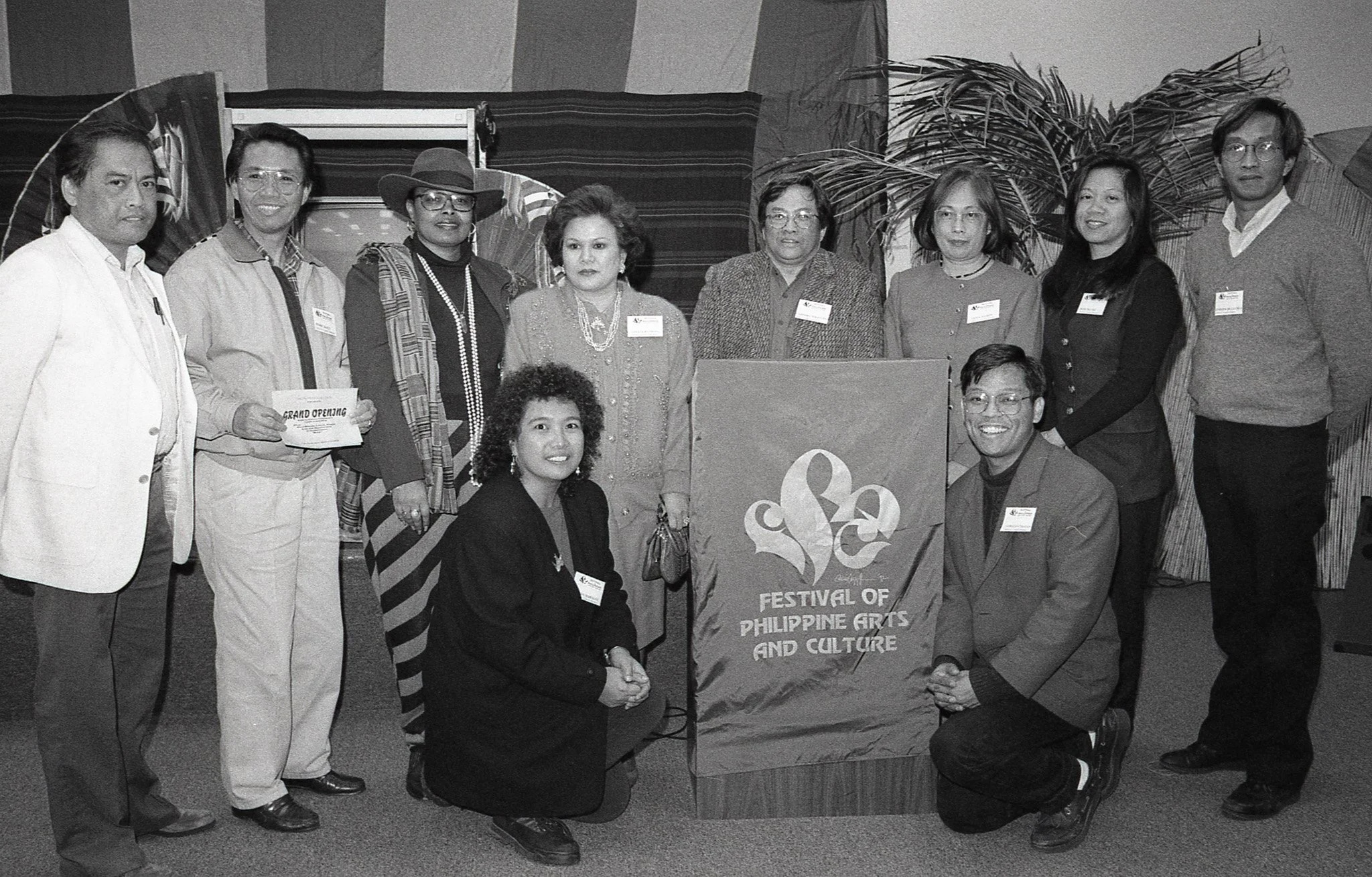
First person: unknown, Perry Barit, Rosie Lee Hooks, (fourth person: unknown), Cas Tolentino, Rose Ibanez, Enrique De La Cruz
Kneeling: Linda Mabalot, Gerald Gubatan.
Photo courtesy of Visual Communications.
In the 1990s, SIPA served as the fiscal agent for the Festival of Philippine Arts and Culture (FPAC), which was a purely artist-driven effort. In 1992, in the aftermath of the Los Angeles civil unrest, the artists made the decision to proceed with the very first FPAC at Los Angeles City College. By the late 1990s, community stakeholders were debating: Should the arts and culture agenda be led by SIPA, or should there be a separate community arts institution? Fil-Am Arts was born, and I became its founding board president in the early 2000s.
By that time, I was working in Sacramento for then–State Assembly Member Jackie Goldberg. That year, Fil-Am Arts organizers made a trip to Sacramento and returned with grant resources from the California Arts Council. We witnessed the power of community organizing and political advocacy. Uncle Roy used to say, “Out of sight, out of mind.” Well, I’m glad we spoke up, secured resources, and helped launch Fil-Am Arts!
Gerald Gubatan recounts the beginnings of FPAC and FilAm Arts as a part of SIPA’s legacy.
What do you think is needed for SIPA and the Historic Filipinotown community to continue its legacy?
To remain relevant and thriving today, SIPA must continue to develop effective leadership in new generations, strengthen the institution, cultivate and diversify strong support, and never forget where it came from.
Uncle Roy, always the community activist, encouraged self-knowledge through cultural identity, connected contemporary issues with social policy and politics, and literally and metaphorically kicked the SIPA ball.
He was actively engaged in the Filipino American experience while reminding us of our collective history of resisting colonialism and overcoming racism in America. He embodied the Search to Involve Pilipino Americans in community empowerment.